
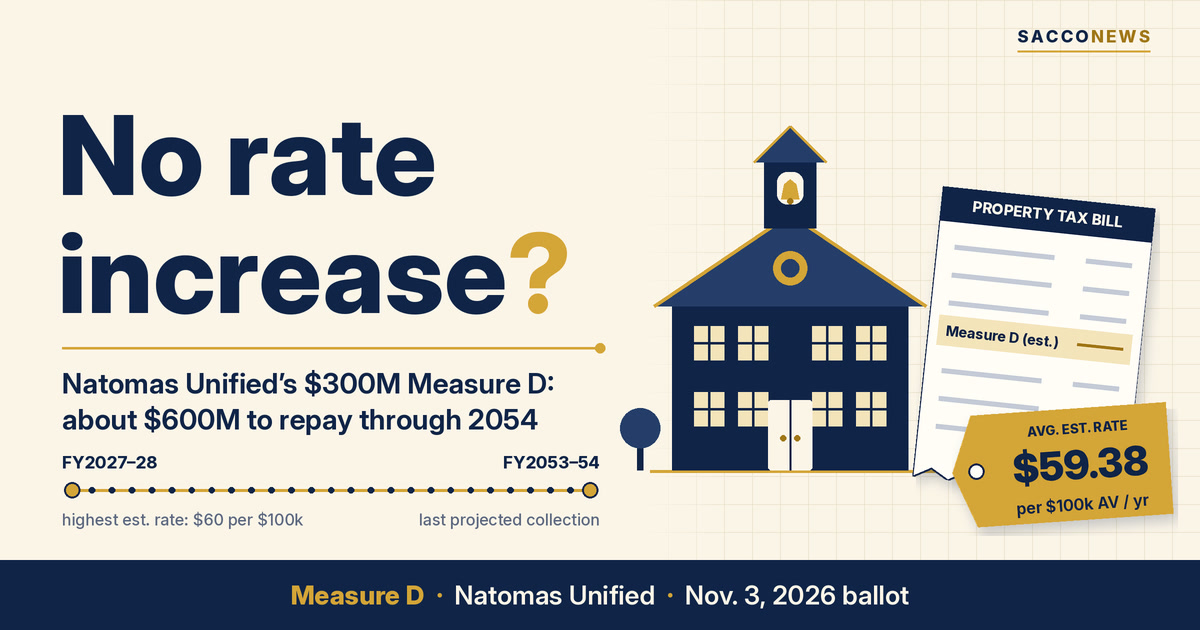
On the Nov. 3 ballot, Natomas Unified’s Measure D promises repairs, safety upgrades, and classrooms without raising the tax rate. The fine print is who pays, for how long, and what else is already on the same bill.
Measure D at a glance: $300 million borrowed, about $600 million repaid through FY 2053–54. Credit: Sacconews original.
Natomas Unified School District is asking voters on November 3, 2026, to authorize up to $300 million in general obligation bonds for school repairs, safety work, career-training space, and growth classrooms. The Natomas Schools Repair, Safety, Education Measure needs 55% approval, not a simple majority.
For households already carrying California’s stacked property-tax load, the wallet question is not only whether schools need work. It is who pays, how much against assessed value, how long the levy lasts, and how this stacks with other Nov. 3 asks, including Los Rios Measure H for owners in both jurisdictions.
What’s on the ballot
Sacramento County’s official text asks whether NUSD may issue $300,000,000 in bonds “at legal rates,” levy about $60 per $100,000 of assessed valuation, raise roughly $22 million a year while bonds are outstanding, and require oversight, disclosure, audits, and a ban on bond spending for administrators’ salaries.
The tax rate statement and County Counsel analysis add more detail:
- Average annual rate: about $59.38 per $100,000 AV
- Highest estimated rate: $60, first applying in FY 2027–28
- Last projected collection year: 2053–54
- Total principal plus interest if all bonds sell: about $599.9 million, or roughly two dollars out for every dollar borrowed
Source: Sacramento County current measure information.
Household cost examples (assessed value, not market price)
Bond levies run against assessed valuation on the county roll. That is often below sale price for longtime owners and closer to it for recent buyers. Using the district’s average of $59.38 per $100,000 AV:
- $400,000 AV: about $238 a year
- $600,000 AV: about $356 a year
- $800,000 AV: about $475 a year
At the ballot’s rounded $60 per $100k, those examples are about $240, $360, and $480 a year. Check your tax bill for your AV and exemptions.
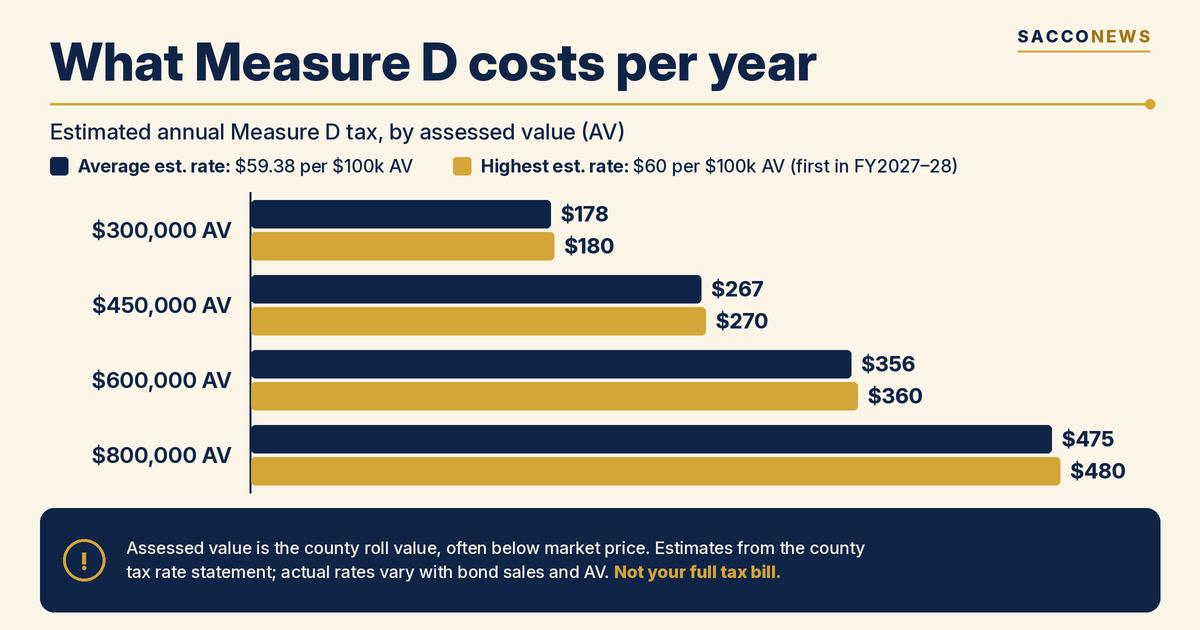
Estimated annual Measure D cost by assessed value, from the county tax rate statement. Not your full tax bill. Credit: Sacconews original.
What the money is supposed to buy
NUSD covers about 38 square miles in northwestern Sacramento County and Natomas, with roughly 17,000 students across district and associated charter campuses. Authorized work includes repairing or replacing roofs, HVAC, plumbing, and electrical; safety, security, and ADA upgrades; hazardous-materials remediation; career technical and STEM labs; replacing aging portables; and adding classrooms and, if needed, new schools for growth, plus energy projects and site work.
Accountability mirrors Prop. 39 rules: a citizens’ oversight committee, annual independent audits, a dedicated bond account, and no bond dollars for administrator salaries. State matching funds are hoped for but not guaranteed. District framing: NUSD facilities and Measure D page. Campaign materials also cite VoteNatomasKids.com.
Note: NUSD had a 2006 Measure D (about $145 million), plus Measure J (2014) and Measure L (2018). The 2026 Measure D is a new $300 million ask, not a continuation of the old series under the same letter.
“No rate increase” vs. extending the tax horizon
The filed Argument in Favor, signed by State Sen. Angelique Ashby, NUSD board president Micah Grant, Sacramento Vice Mayor Karina Talamantes, and Councilmember Lisa Kaplan, says Measure D “will not raise your tax rate,” that most homes will see no rate change, and that some “may see a slight reduction.”
That claim is about the rate relative to outstanding NUSD debt as older bonds are paid down. It is not about whether a new multi-decade levy exists. The tax rate statement still projects a dedicated Measure D levy near $60 per $100k AV into the early 2050s, with total debt service near $600 million. Extending how long owners send money to bondholders is a real fiscal choice, even when the rate is marketed as flat.
No argument against was filed. That is a ballot fact, not proof of consensus: the official pamphlet will not carry a formal opposition brief.
Stacking with Los Rios Measure H
Many Natomas owners also sit inside Los Rios’s School Facilities Improvement District No. 1. On the same ballot, Measure H asks for $1.1 billion in college bonds, with an estimated average levy of about $16.55 per $100,000 AV (collection through FY 2050–51; total repayment roughly $1.79 billion). Los Rios likewise markets “no increase” as older college debt rolls off.
If both pass, a rough average stack for overlapping owners is about $76 per $100,000 AV from these two measures alone. That works out to roughly $304, $456, and $608 a year at $400k, $600k, and $800k AV, on top of base property tax and other local charges. Sources: Sacramento County measure page; Los Rios Measure H.
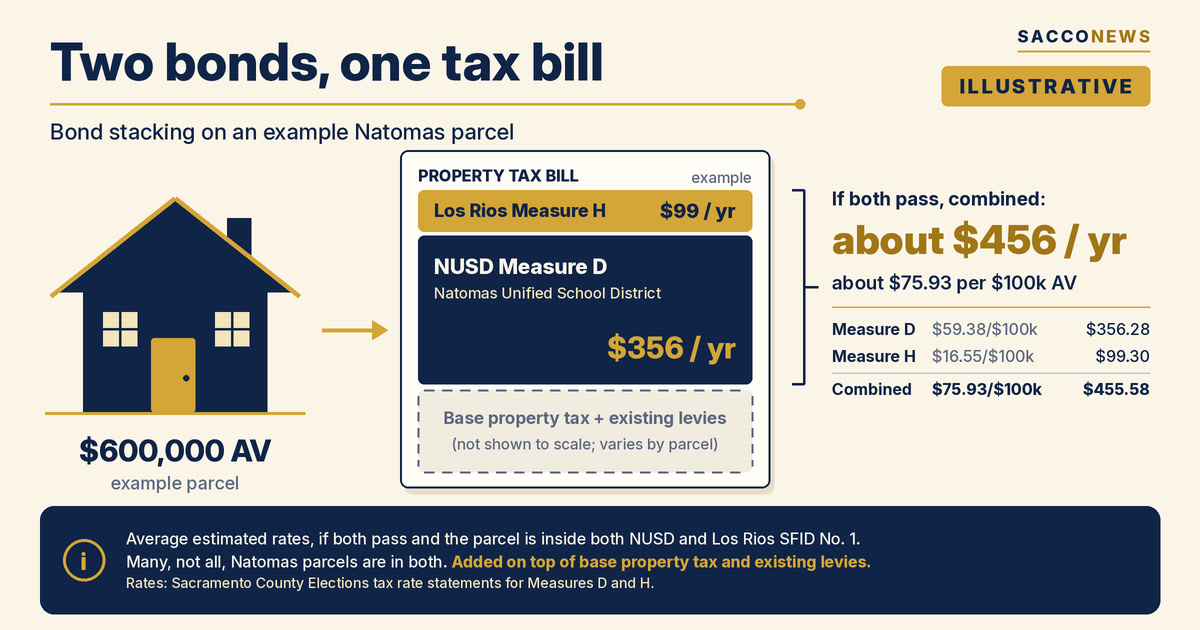
Illustrative: two bonds on one example $600,000 AV parcel inside both NUSD and Los Rios SFID No. 1. Credit: Sacconews original.
California’s school-bond bar at 55% clears more easily than a two-thirds tax. A lower threshold, no filed opposition, and “rate won’t go up” messaging is a familiar package.
If Measure D fails
A “no” vote does not erase deferred maintenance. It does mean this $300 million authorization, and the local match posture for state facilities dollars, does not move forward as written. Roofs, HVAC, security, accessibility, CTE labs, and growth classrooms would compete again for developer fees, state programs, operating budgets, or a future ballot. The district argues delay makes fixes more expensive; the repayment calendar is the counterweight.
Practical next steps
- Election Day: Tuesday, November 3, 2026, plus county vote-by-mail and early voting options.
- Confirm you’re in NUSD: check your tax bill’s taxing agencies, county voter and district lookup tools, or maps at elections.saccounty.gov. NUSD boundaries are not identical to “Natomas” labels or city limits.
- Read the full text, tax rate statement, and arguments: County measure page.
- District materials: NUSD facilities page.
School facilities are real costs. So is compounding debt on assessed value through mid-century. Measure D puts both on the November ballot in clear dollars, if voters look past the rate slogan to the repayment calendar.
Primary sourcing: Sacramento County Elections measure page (ballot question, County Counsel analysis, full text, tax rate statement, arguments); NUSD facilities page.
Comments
No comments yet. Be the first — comments appear after a quick review.
Leave a comment
Comments are reviewed before they appear publicly.